
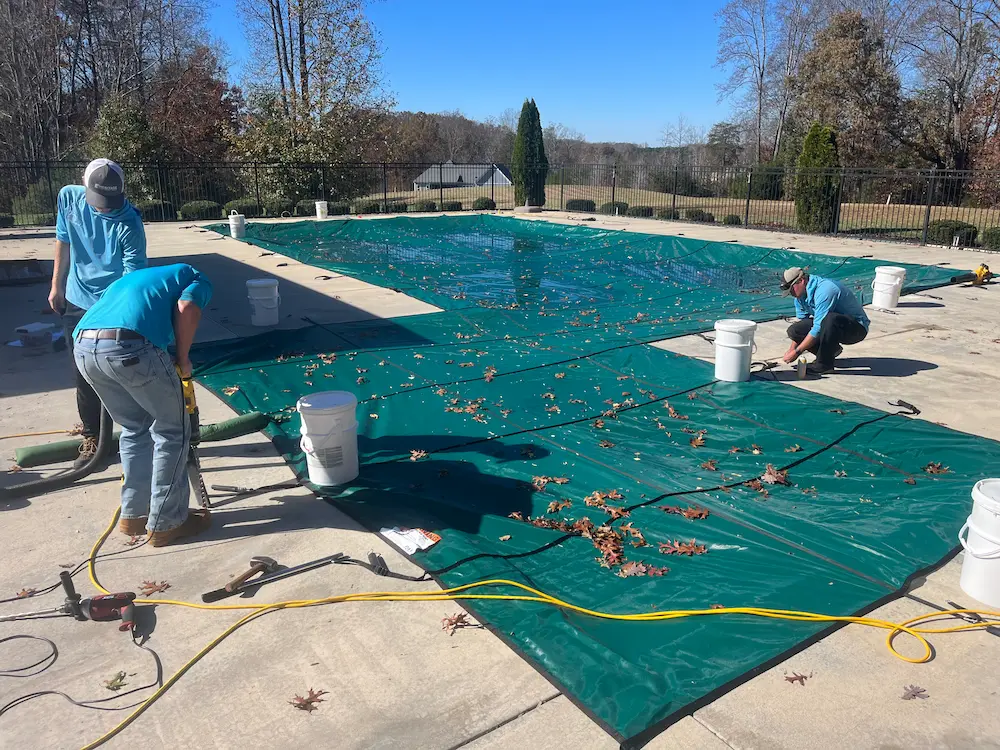
If you are shopping for a safety cover for your pool, start with the two types. Automatic safety pool covers open and close with a motor and a key. Manual safety covers are anchored to the deck and put on and taken off by hand. They suit different routines.
For more on motorized systems, see our automatic pool covers page.
What makes a cover a safety cover
“Safety cover” has a specific meaning. ASTM F1346 is the ASTM International standard for pool safety covers. It sets performance requirements for safety covers, meant to reduce the risk of drowning by limiting young children’s access to the water when the cover is installed and used according to the manufacturer’s instructions. It also sets labeling requirements for all pool covers.
So the question to ask about any cover, automatic or manual, is whether the maker states it meets ASTM F1346. Ask for that in writing and check the label on the cover. A floating solar blanket or a loose tarp does not count as a safety cover.
No cover replaces supervision around the water, and a cover only works as a barrier while it is fully closed and secured.
How a manual safety cover works
A manual safety cover is a large, custom-fit panel of mesh or solid fabric. Straps around its edge connect by springs to anchors set into the deck. When the cover is on, it is stretched tight across the pool. When it is off, the anchors sit flush with the deck.
Putting it on and taking it off is a hands-on job that takes time and often more than one person. That is why manual safety covers are mostly used to close the pool for the off-season, not to cover it every night.
Manual covers come in two main types.
Mesh covers let rainwater drain through, so you do not need a pump on top. Fine debris and some sunlight get through as well, which means a bit more cleanup when you open the pool.
Solid covers block sunlight and debris. They hold rainwater on top, so they need a pump or drain panel to deal with it.
How an automatic safety cover works
An automatic cover is a sheet of heavy fabric wound onto a roller at one end of the pool. Its edges ride in tracks along each side. Turn the key and a motor either rolls the cover out across the water or winds it back up. A small pump on top moves rainwater off.
Because it opens and closes in moments, an automatic cover is built for daily use. You can close the pool every evening and any time you leave the yard. If you want a deeper look at the parts, read how retractable pool covers work.
How they compare
Daily use
This is the biggest difference. An automatic cover is quick to close, so it is practical to close after every swim. A manual cover is realistic for the off-season. Few people pull one on and off between swims.
Pool shape
Manual safety covers are custom-made to your pool’s outline, so they fit most shapes, including freeform pools and pools with steps or spas. Automatic covers run in straight, parallel tracks. Rectangular pools are the easiest fit, and freeform pools can take more planning and deck work.
Look of the deck
A manual cover leaves small anchors in the deck when it is off. An automatic cover needs tracks along the sides, visible or tucked under the coping, plus a lid or housing over the roller at one end.
Upfront cost
A manual safety cover usually costs less than an automatic system. An automatic cover is a motorized system with more parts and more installation work. Our post on automatic pool cover cost walks through what drives that price.
Upkeep
Manual covers need their straps and springs checked and the cover cleaned and stored properly when it is off. Automatic covers have moving parts. The ropes and pulleys need attention over time, as does the motor, and the cover pump has to keep working. We cover the common issues in our automatic pool cover repair guide.
Heat and water
An automatic cover that closes every night holds heat in and cuts evaporation all season. A manual cover does that job only while it is on, which is mostly the off-season.
Which one fits your pool
An automatic safety cover tends to fit best if you use your pool often or heat your pool and want to hold that heat. A manual safety cover tends to fit best if you mainly want a secure winter cover, have a pool shape that tracks cannot follow, or want a lower upfront cost.
Some owners use both, with an automatic cover in season and a manual safety cover for winter. We can talk through what makes sense for your pool and your routine.
Frequently Asked Questions
Are automatic safety pool covers as safe as manual safety covers?
Either type can be a safety cover if it meets ASTM F1346. Check the maker’s statement and the label on the specific cover.
What is ASTM F1346?
It is the ASTM International standard for swimming pool safety covers. It sets performance requirements meant to reduce drowning risk for young children, plus labeling requirements for all covers.
Can I use a manual safety cover every day?
You can, but most people do not, because putting one on and taking it off takes time and often more than one person. That is why manual covers are mostly used for the off-season.
Does an automatic cover work on a freeform pool?
Often, with more planning and deck work, since the tracks have to run straight. Manual safety covers are custom-cut, so they fit freeform shapes more easily.
Does a safety cover replace a pool fence?
Ask your local building department what your pool needs for barriers. Treat any cover as one layer of protection. Supervision still comes first.
Where Pinnacle fits
Pinnacle Pool Service installs and repairs automatic pool covers on in-ground pools across the Piedmont Triad and the Triangle, including covers added to existing pools. We can usually quote an automatic cover from photos of your pool, which you can text to us.
Separately, we are an authorized service and warranty provider for pool equipment brands including Latham and LoopLoc, and our authorized warranty work covers safety covers among other components, though not automatic covers.
Want help choosing? Contact us, or call the Triad at (336) 383-1500 or the Triangle at (984) 500-0454.