
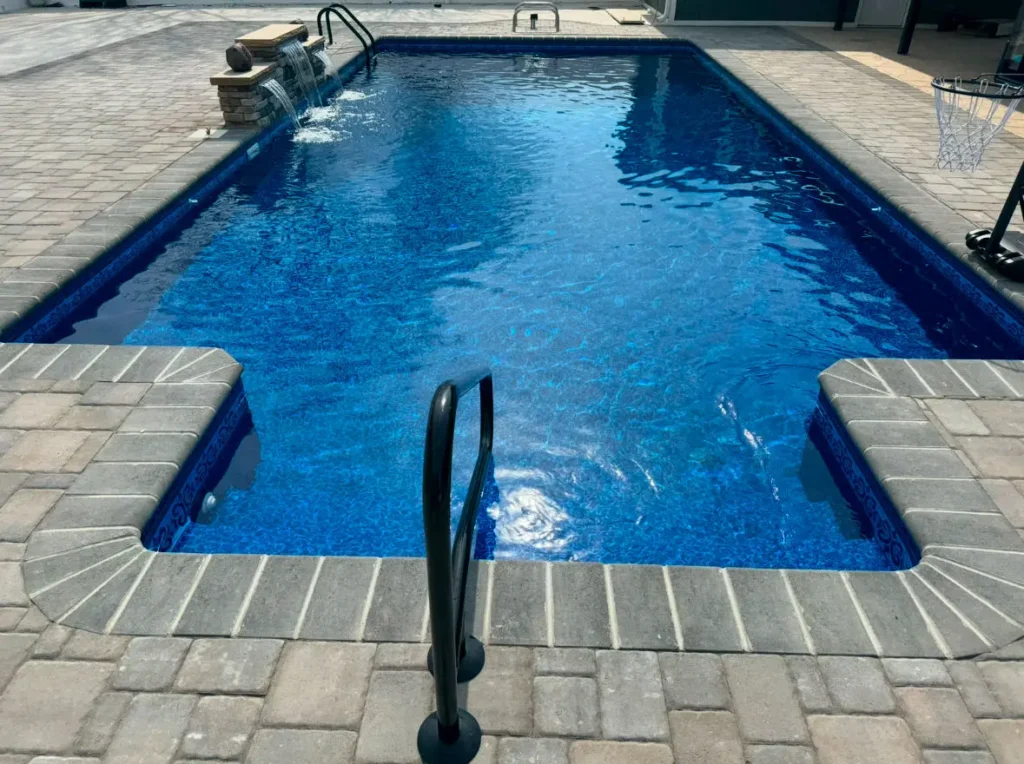
Your pool does not have to be new to get an automatic cover, and plenty of pools that have been around for years can take one. This guide walks through automatic pool cover installation on an existing pool, from the first photos you send to the day you run the cover yourself, so you know what to expect before anyone starts measuring. If you would like an overview of the covers themselves first, along with repair, see our automatic pool covers page.
Can your pool take an automatic cover?
Most of the answer comes from four things you can look at in your own backyard.
Shape. Automatic covers run in straight, parallel tracks down the long sides of the pool, which makes a rectangular pool the simplest fit. A freeform or kidney-shaped pool can often still take one, but the tracks have to sit outside the curves, and that can mean a different track layout or added decking.
Room at one end. The cover winds onto a roller, called a drum, at one end of the pool. That drum needs space, either in a box recessed into the deck or in a housing that sits on top of it.
Deck and coping. The tracks attach along the pool edge, so the condition of your coping and deck shapes which track style will work and how much prep the job needs.
Power. The motor runs on electricity, so it needs a power supply near the drum end of the pool.
Your track options
There are three ways to run the tracks. Under-track systems hide beneath the coping, recessed tracks sit flush in a channel cut into the deck, and deck-mounted tracks sit on top where you can see them. On an existing pool, each style asks for a different amount of change to the edge of the pool.
Deck-mounted tracks
Deck-mounted tracks sit on top of the deck right at the pool edge. Because they need less change to the coping, they are usually the most direct way to add a cover to a pool that is already finished, and the trade-off is that the tracks stay visible.
Under-track and recessed tracks
Under-track and recessed systems tuck the tracks beneath the coping or flush into the deck, so the cover looks as though it was built with the pool. On an existing pool that usually means changing the coping or cutting into the deck. If you are already planning new coping or other pool renovation work, the same project can be a good time to add one of these systems.
Where the drum and motor go
At the drum end of the pool, the choice is about how the mechanism looks once the job is done. A recessed box sits below the deck with a lid flush to the surface, which keeps the deck clean and open but means cutting into the deck at that end. A deck housing sits on top of the deck and covers the drum, so the deck stays as it is, and some owners build the housing into a bench or a low wall so it feels like part of the yard.
What installation looks like, step by step
Every pool is a little different, but the work on an existing pool generally follows this order:
- Photos and quote. At Pinnacle, this usually starts with photos of your pool that you text to us. We can typically quote a cover from photos, and we prefer it. You get a written quote by text or email that lists each part of the work and its cost, along with a schedule.
- Plan. You settle on the track style, where the drum goes and the cover fabric. A good quote spells out any deck, coping or electrical work.
- Prep work. If the job needs a recessed box, coping changes or a new electrical circuit, that happens first.
- Tracks and drum. The tracks go in along each side of the pool, and the drum and drive go in at one end.
- Fabric and ropes. The cover fabric is fitted to the drum and the tracks, and the ropes that pull it closed are set.
- Adjustment and testing. The open and closed stop points are set and the cover is run through full cycles until it tracks straight.
- Walkthrough. You learn how to run the controls, how to use the cover pump and what to keep an eye on.
The written quote lays out the schedule for your pool, so you know the order of work before anything starts. Most Pinnacle projects start within three to four weeks of signing, depending on the project. Once work begins, we keep you posted by call or text as each stage wraps up.
How to get ready
A little preparation before install day makes the work go smoothly. Move patio furniture and planters away from the pool so the edges are clear, and make sure the installers will have an easy path from the driveway or gate to the pool. If there are sprinkler lines, lighting or anything else buried near the pool edge, let us know ahead of time so it can be planned around.
Living with your new cover
Day to day, a few habits keep an automatic cover working well:
- Open the cover all the way before anyone gets in the pool
- Keep the key out of reach of children
- Keep the cover pump running whenever water sits on top
- Clear leaves and grit out of the tracks
- Keep people and pets off the cover
Ropes and other moving parts wear with use, so if the cover starts pulling to one side, making new noises or stopping short, have it looked at before a small problem turns into a bigger repair. Our guide to automatic pool cover repair covers the common signs. Pinnacle also offers maintenance plans for automatic covers, and we recommend a clutch adjustment and a 14-point inspection each year to keep a cover in good order.
Safety standards
If safety is a main reason you want a cover, ask whether the maker states it meets ASTM F1346, the ASTM International standard for pool safety covers. That standard sets performance requirements meant to reduce the risk of drowning by making it harder for children under five to reach the water, when the cover is installed and used according to the manufacturer’s instructions. Even the best cover works alongside adult supervision and never replaces it.
Frequently Asked Questions
Can you add an automatic cover to an existing in-ground pool?
Yes, many existing pools can take one. The shape of the pool, the room at one end for the drum and the condition of the deck decide how much work it takes.
Do I need to redo my coping for an automatic cover?
Not always. Deck-mounted tracks sit on top of the deck and usually need little coping work. Under-track systems that hide beneath the coping often do mean changing it.
How soon can automatic pool cover installation start?
Most Pinnacle projects start within three to four weeks of signing, depending on the project. How much prep the pool needs, such as a recessed box, coping changes or a new electrical circuit, is part of what sets the schedule in your written quote.
Can I install an automatic pool cover myself?
We do not recommend it. The system has to track straight, stop at the right points and be installed to the manufacturer’s instructions to work as intended.
Do I need a permit?
Permit rules vary by town and by the electrical work involved. Ask us about it when you get in touch.
Getting a quote
The cost of a cover depends on your pool and deck as well as the cover you choose, and the photos you text us are usually enough for a quote. Our post on automatic pool cover cost explains what drives the price. A cover install over $6,000 qualifies for financing through Lyon Financial.
Pinnacle Pool Service is a family-owned local company, licensed and insured, and we install automatic covers on existing in-ground pools across the Piedmont Triad and the Triangle. We would be glad to talk through your pool with you. Contact us to ask about a cover, or call the Triad at (336) 383-1500 or the Triangle at (984) 500-0454.